a
Private live sessions
Eight working sessions of 90 minutes, on your idea. Not a lecture with your name on the invite: we design and build your product together, on screen.
Design an app the way senior product designers do. Then build the real thing with AI and put it on the internet. One student, one mentor, one shipped product.
Most AI courses get you from prompt to screen in an afternoon. The screen works. It also looks like every other screen the model has ever produced, and it solves a problem nobody defined.
This program runs the other way. We spend five of the eight sessions on design: framing the product, structuring the experience, building a visual language and a real design system. Then we hand that system to AI tools and build the actual app. The build goes fast precisely because the design decisions were already made.
I'm Saeed. I've spent 15+ years designing fintech and streaming products, including a mobile bank and a VOD platform with millions of users, and I now run my own AI marketplace startup. Everything in this course is the workflow I use on my own products, not a tool tour.
Eight working sessions of 90 minutes, on your idea. Not a lecture with your name on the invite: we design and build your product together, on screen.
Each session ends with a concrete next step on your project. Plan for 4 to 6 hours a week including the session itself.
Send your work between sessions and get written feedback on both the design and the code. You don't wait a week to find out something's off.
The program ends with your app on a live URL, a design system in Figma, a GitHub repo with your name on it, and a written case study for your portfolio.
We take your idea apart and put it back together as a PRD and design brief: the problem, the user, the scope, and what "done" means. This document drives every session after it.
User journeys, information architecture, and screen flows. UX Pilot's Autoflow drafts the flows in minutes; your job is to catch what it got wrong, which is where the actual UX skill lives.
Visual identity, typography, and tone. We work on the hardest problem in AI design: getting output that doesn't look like a template, and knowing why it doesn't.
Color and type tokens, spacing, components with states. We run UX Pilot's design review as a heuristic check, then decide which of its complaints deserve fixing.
Every screen of your app at full fidelity, built from your own system, wired into a clickable prototype. Predictive heatmaps tell us where attention lands before a single user does.
Your Figma tokens become Tailwind config; your components become real ones. Git is introduced as one thing only: the undo button that makes the next two sessions safe.
We assemble the working app: real data, sign-up and login, the features from your PRD. You direct Claude Code; it types. You'll be surprised who's the bottleneck.
Deploy to a live URL, QA the app against your design, fix what drifted. Then we write your case study together, using the same structure I use for my own portfolio.
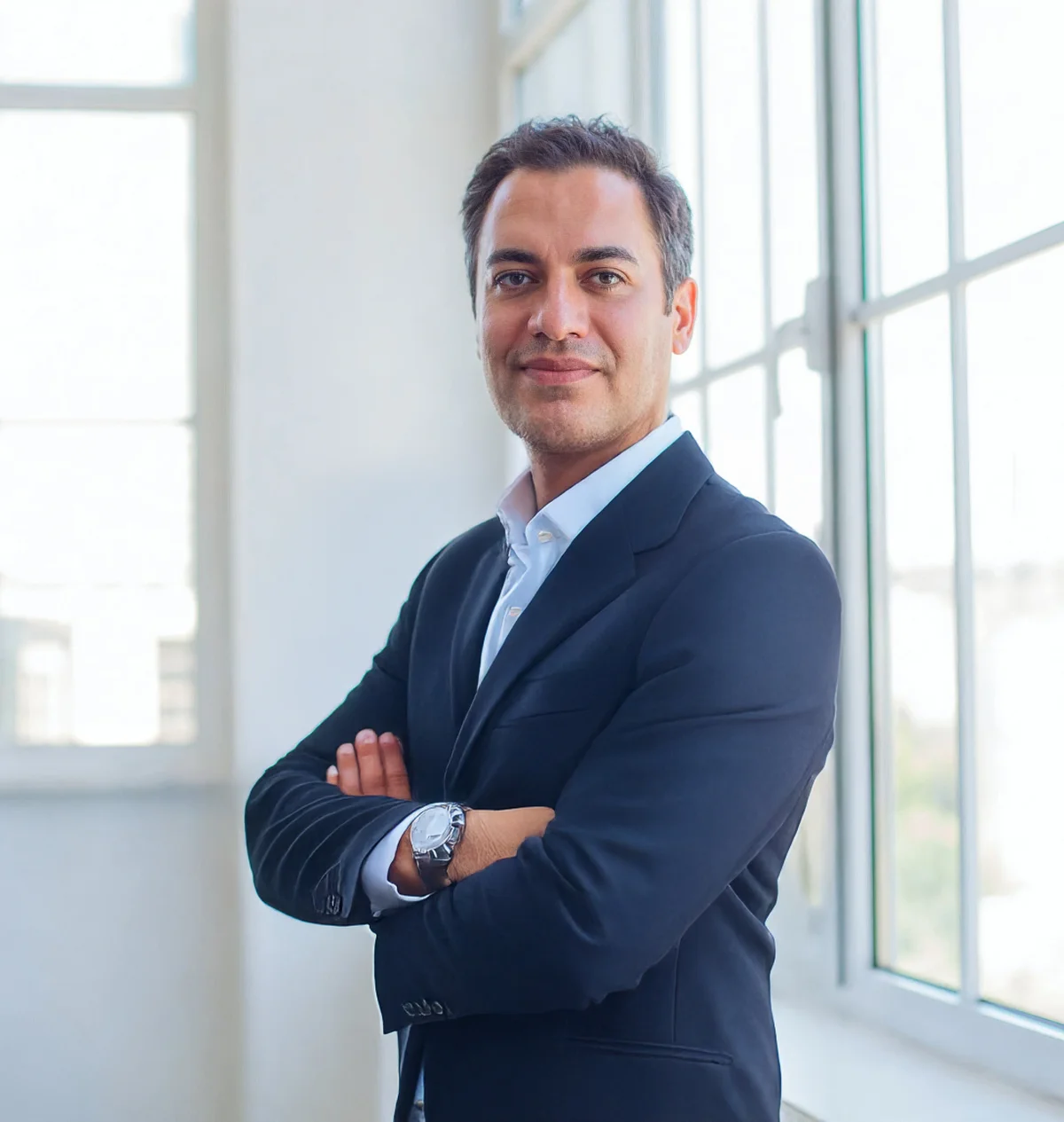
I've been designing digital products for over 15 years. Six of those were at Dotin, where I led a 13-person UX team on banking products used by 20M+ people and redesigned Bank Pasargad's app (3.0 to 4.8, over a million downloads). I was the founding product designer of Sheida, a recommendation-driven streaming platform, and led its product for three years. Right now I'm building Glue, an AI marketplace for home services in Canada.
Every screen, token and deployment in this course comes from that daily work. In a cohort course you watch an instructor design an example product. Here, the example product is yours, and I sit beside you while it becomes real.
"I had an idea for a service startup and no technical team. A month after we started, the app was published. I still don't fully believe it." Reza · founder, service startup
"What I valued most: we worked on my real project the entire time. No abstract exercises, no fake portfolio piece. Everything I learned, I used the same week." Mona · fashion business owner
If after session 2 this isn't working for you, say so and get a full refund. No form, no questions.
The course doesn't end at session 8. It ends when your app is on a live URL. If we need extra async rounds to get there, they're included.
If you later bring the product to my studio to scale it with a full team, the course fee counts toward that project.
No. You need to be willing to read code without panic while an AI writes it. Sessions 6 to 8 will feel new, and that's the point; nothing in them assumes prior programming.
Some. If you can find your way around Figma and have designed anything before, even badly, you're fine. Complete beginners should start with a foundations course first; this program moves too fast to teach what a frame is.
Plan for about $20 to $40 a month during the program, mostly the Claude subscription. UX Pilot has a free tier that covers our use, and Figma, Supabase, Vercel and GitHub free plans are enough. No annual contracts for anything.
It's already replacing designers who only push pixels, because pixel production is now nearly free. What it can't replace is knowing what to build and why a design is wrong. This course moves you to that side of the line, and hands you the production speed too.
We agree the schedule together at the intro call, one to two sessions a week. I'm in Istanbul (UTC+3) and hold sessions from morning to late evening, which covers Europe fully and most of North America's morning. Sessions run in English or Persian, your choice.
Four to six. That's the 90-minute session plus homework on your own product. If a week goes sideways, we reschedule; that flexibility is most of what you're paying for in a private format.
Four things: your app on a live URL, a GitHub repository in your name, a design system in Figma, and a written case study. All four are yours, on your accounts. Nothing lives on my infrastructure.
Those are good cohort programs, and if you want a certificate and a peer group, look at them seriously. The differences here: it's private, so the course adapts to you instead of a syllabus; you work on your own product instead of a class exercise; and the design half goes deeper because I'm not teaching to the middle of a group.
We move it. There is no cohort to fall behind; the calendar is ours to rearrange. Repeated no-shows are a different conversation, and it's one I'll have with you honestly.
Yes, a signed certificate of completion. But I'll be straight with you: the live URL and the case study will do more for your career than any certificate. Interviewers click links; they don't verify PDFs.
Yes, this fits most learning and development budgets. I provide a proper invoice, and if you need help making the case, I'll send you a short email template for your manager that explains the outcomes in their language.
Tell me any time before session 3 and I refund the full amount, without a reason required. After that, we've built too much together for a clean undo, which is also true of the app.